


CONTENT NOTE: The following article references substance use, opioid overdoses and naloxone.
New Hampshire has been one of the states hit hardest by the opioid epidemic.
The Granite State did not see a significant dip in statewide overdose deaths until 2024, after a decade of high drug death rates. Experts say this decline is largely due to New Hampshire’s effort to create widespread availability of naloxone, a life-saving medication that can reverse an opioid overdose.
This International Overdose Awareness Day, we sat down with John Letendre, LADC, continuum of care facilitator for Cheshire’s Center for Population Health, and Madilyn Hibbert, BSN-RN, WCC, of The Doorway at Cheshire, to discuss naloxone and how to use it properly.
What is naloxone?
Naloxone is a life-saving medication that can reverse an overdose from opioids—including fentanyl, heroin and prescription opioid medications—when given in time. Naloxone comes in two forms: prefilled nasal spray and injectable. The nasal spray is the only form that does not require a prescription.
Naloxone quickly reverses an overdose by blocking the effects of opioids. It can restore normal breathing within two-to-three minutes in a person whose breath has slowed, or even stopped, as a result of opioid overdose.
What does an opioid overdose look like?
Signs of an opioid overdose may include:
- Unconsciousness or unresponsiveness (doesn’t wake when shaken or called)
- Shallow breathing
- Limpness
- Blue or dark purple lips, gums or fingertips
- Pinpoint pupils
- Slow or irregular heartbeat or pulse
- Snore-like gurgling noise
How do I use naloxone?
If you see someone having an opioid overdose, immediately check the area for safety and call 9-1-1.
New Hampshire’s Good Samaritan Law allows people to call emergency services without fear of arrest if they are having a drug overdose that requires emergency medical care or if they witness someone overdosing.
After calling 9-1-1, you can begin the following steps for administering naloxone:
LAY: Check for slowed breathing or unresponsiveness. Lay the person on their back and tilt their head up.
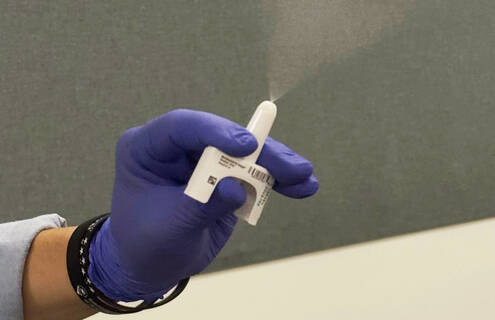
SPRAY: Insert device into either nostril and press plunger firmly.
STAY: Place the person on their side in the recovery position. Continue to administer doses every two-to-three minutes, if needed, and wait with the person until emergency help arrives.
Guidelines for administering naloxone are updated constantly to ensure best practice. For the most up-to-date naloxone instructions, visit the following websites:
Who should carry naloxone?
Anyone can carry naloxone and potentially save a life by giving it to someone experiencing an opioid overdose. Over the last decade, the vast majority of drug-related deaths in New Hampshire were from an unintentional overdose of opioid or opiate drugs.
Where can I get naloxone training?
Cheshire’s Center for Population Health offers 30-minute naloxone trainings at community organizations. To sign your organization up for an on-site training, contact the Center for Population Health at 603-354-5460 and press 5 for the on-the-go training line. Trainings are also offered locally through the American Red Cross.
Where can I get naloxone?
The Doorway offers naloxone for free. Naloxone is also available over-the-counter at most local pharmacies. You can also ask your primary care provider for a prescription.
If you or a loved one is struggling with a substance-use disorder, The Doorway—a recovery services referral hub at 24 Railroad St. in Keene—is open Monday through Friday, 8 am to 5 pm. You can reach The Doorway in Keene during business hours at 603-354-6675. Support through the state’s 24/7 hotline is also available at 2-1-1.