



Hitting the Slopes? Prevent ACL Injury with Tips from a Dartmouth Health Sports Medicine Specialist

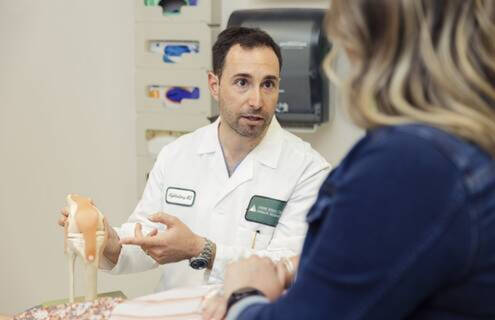
Neal B. Goldenberg, MD, MA, an orthopaedic surgeon and chair of sports medicine at Dartmouth Health’s Cheshire Medical Center, displays a model of the bones and tendons of the knee.

The whole point of a prevention program is that it's easy for anybody to do. Typically, the program doesn't need to last more than 20 minutes and only needs to be done two to three times a week.

Neal B. Goldenberg, MD, MA

Most K-12 students in New Hampshire will have their winter break from February 26-March 1 this year, and many Granite State families will use that time to hit the slopes. Skiing and snowboarding is a great way to get outside and enjoy the season here in northern New England, but like any sport, it comes with risk of physical injury, especially if you don’t prepare your body ahead of time.

One common—and also painful and debilitating—injury caused by skiing and snowboarding is tearing of the anterior cruciate ligament, or ACL. “What happens is the tibia, or the shin bone, moves forward in relation to the femur, tearing the ACL,” said Neal B. Goldenberg, MD, MA, an orthopaedic surgeon and chair of sports medicine at Dartmouth Health’s Cheshire Medical Center. “Often, this happens when the knee is no longer directly above the toes. So, if you think about the position of someone cutting, and they're more kind of ‘knock-kneed’ at that time, they’re at higher risk for an ACL injury.”

By working on strength, balance, plyometrics and body awareness, people can guard against possible ACL tears, Goldenberg said. Starting these exercises a week or two before a planned ski trip is ideal, but starting even a few days ahead has benefits. Here are some exercises to consider, courtesy of the Multicenter Orthopaedic Outcomes Network Knee Group, with modifications available to best suit your level of fitness:

Strength:

  • Plank (push-ups)
    • Level 1: Both legs
    • Level 2: Alternate legs
    • Level 3: One leg lift
  • Side plank
    • Level 1: Static
    • Level 2: Dynamic
    • Level 3: With leg lift

Balance:

  • Single-leg balance
    • Level 1: Hold the ball
    • Level 2: Throwing ball with partner
    • Level 3: Test your partner
    • Level 4: Throwing ball with partner on wobble-board
    • Level 5: Test your partner on the wobble-board

Plyometrics:

  • Squats
    • Level 1: With toe raise
    • Level 2: Walking lunges
    • Level 3: One-leg squats
    • Level 4: Squats with toe raise on wobble-board
    • Level 5: One-leg squats on wobble-board

Jumping:

  • Level 1: Vertical jumps
  • Level 2: Lateral jumps
  • Level 3: Box jumps
  • Level 4: One-legged jumping sequence
  • Level 5: Box jumps with partner

Running exercises:

  • Running over a field – If you’re rehabbing after ACL surgery, you’ll begin walking on smooth surfaces before advancing to jogging and running and then on grass or other uneven surfaces.
  • Bounding run (basically high knee skipping)
  • Running and cutting
  • Running through a course
    • Hip out
    • Hip in
    • Circling
    • Running and jumping
    • Quick run

“It doesn’t need to be a very long or intensive routine,” Goldenberg said. “The whole point of a prevention program is that it's easy for anybody to do. Typically, the program doesn't need to last more than 20 minutes and only needs to be done two to three times a week.”

About Cheshire Medical Center

Cheshire Medical Center (Cheshire) advances the health and wellness of individuals across New Hampshire’s Monadnock Region through outstanding care and exceptional service. Cheshire teams deliver an impressive range of clinical services that support the community's needs. As a member of Dartmouth Health, Cheshire is able to provide services far exceeding those of a typical rural hospital, including extensive programs in primary care, cancer care, cardiology, orthopaedics, and public health. Cheshire patients are also able to access hundreds of highly trained specialists and a depth of clinical and technical resources through its collaboration with Dartmouth Health. Cheshire’s clinical practice is distinguished by an exceptional staff, a strong commitment to safety and quality, and a culture that values the contribution of every staff member and volunteer. Cheshire is the area's largest healthcare provider and leading employer. Along with the services delivered on their Keene campus and satellite locations, the Medical Center partners with local organizations to provide vital services and programs throughout the region. To learn more, call 603-354-5400 or visit cheshiremed.org.

About Dartmouth Health

Dartmouth Health, New Hampshire’s only academic health system and largest private employer, serves patients across New England. Dartmouth Health provides access to more than 2,300 providers in nearly every area of medicine, delivering care at its flagship hospital, Dartmouth Hitchcock Medical Center (DHMC) in Lebanon, NH. Its network of hospitals, outpatient centers, clinics and home care facilities, spans a broad geographical area. Year after year, DHMC is named the #1 hospital in New Hampshire by U.S. News & World Report, and is consistently recognized for high performance in numerous clinical specialties and procedures. Dartmouth Health includes Dartmouth Cancer Center, northern New England’s only National Cancer Institute-designated Comprehensive Cancer Centers and one of less than than 60 total nationally; Dartmouth Health Children’s, which includes the state’s only children’s hospital (Children’s Hospital at DHMC/CHaD) and more than 20 locations around the region; eight member hospitals in Lebanon, Keene, Claremont, Hampstead, and New London, NH, and Windsor and Bennington, VT; Dartmouth Health Home Care; Dartmouth Health Connected Care Center for Telehealth, serving patients as far away as Texas; and more than 30 primary and multi-specialty clinics across New Hampshire and Vermont. Through its partnership with Dartmouth College, Dartmouth’s Geisel School of Medicine and the White River Junction VA Medical Center, Dartmouth Health trains nearly 400 medical residents and fellows annually and performs cutting-edge research and clinical trials with international impact. Dartmouth Health and its more than 16,000 employees are committed to serving the healthcare needs of everyone in the communities it serves and to providing every patient with exceptional, state-of-the-art, personalized care. Learn more at dartmouth-health.org.